


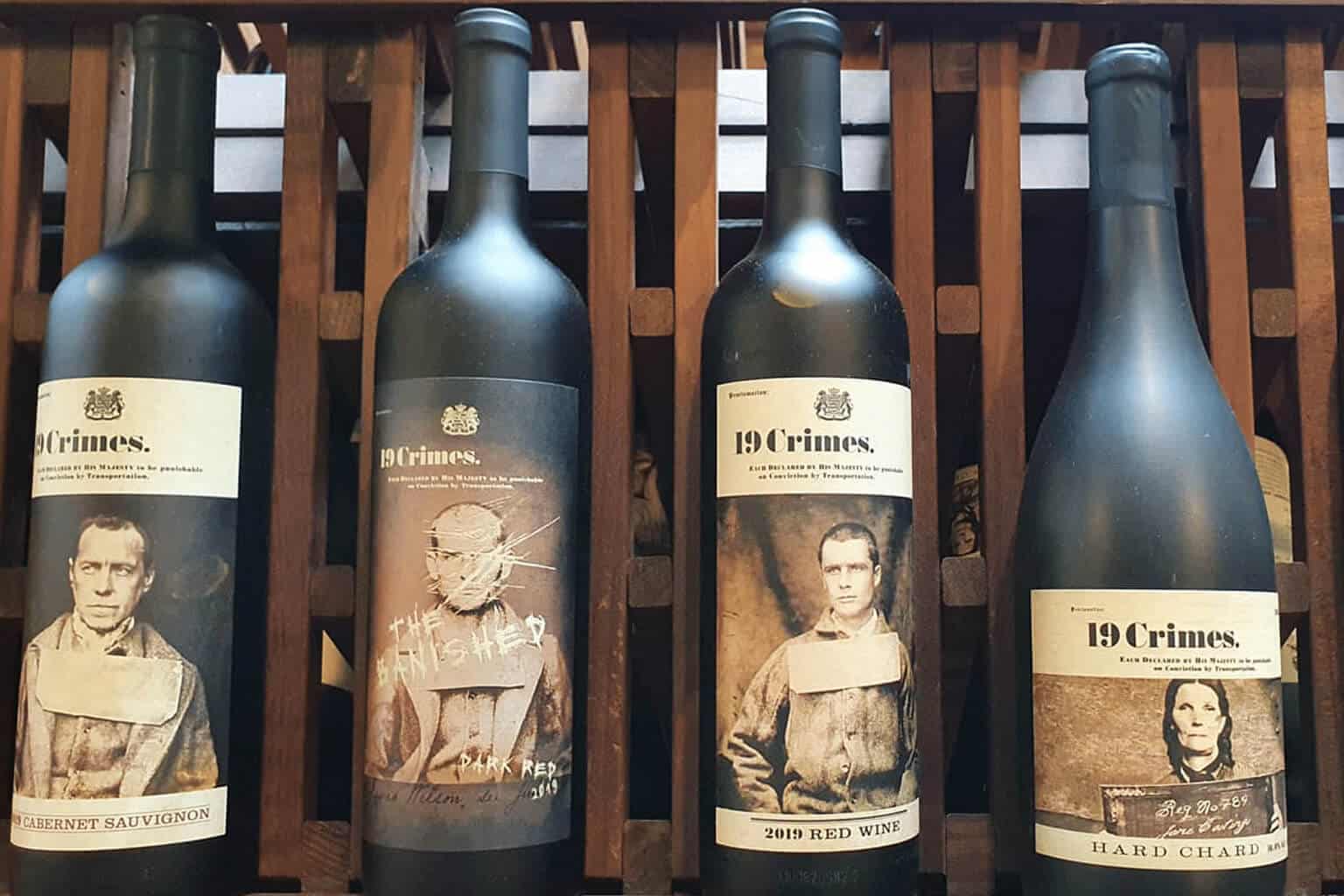
19 Crimes is an Australian wine brand built around the story of British convicts, unusual labels, augmented-reality technology, and massive sales in the United States. So who created it, what’s actually in the bottle, how much does it cost, and why do Americans keep buying it?
If you’ve lived in the U.S. for any length of time, chances are you’ve seen a bottle of 19 Crimes in a wine store.
A black label. The stern face of a 19th-century convict. A name that sounds like it belongs next to a courtroom, not a cheese board.
And that’s exactly what makes the brand so clever.
19 Crimes doesn’t just sell wine. It sells a story, an attitude, and a little bit of rebellion.
And, let’s be honest, American consumers tend to love that combination.
How 19 Crimes Started — and Why There’s a Convict on the Bottle
The 19 Crimes brand launched in 2012 and was created by Treasury Wine Estates (TWE), one of Australia’s largest wine companies. In other words, it’s a corporate brand developed by the TWE team.
But the idea was much more interesting than simply launching another red blend.
The name refers to the British system of punishment used during the 18th and 19th centuries. For certain crimes, offenders could avoid execution and instead be transported to Australia — literally to the other side of the world. The transportation system began in 1787.
That’s where the brand’s marketers made a clever move.
Instead of portraying these convicts simply as criminals or losers, 19 Crimes turned them into rebellious, unconventional characters — people who broke the rules, survived the journey, and helped build a new Australia.
The message is roughly:
“You broke the rules? Maybe you were simply too bold for your time.”
For the American market, that’s almost a perfect story.
America has always loved stories about people who challenged the system, started over, and made something of themselves. In that sense, a bottle of 19 Crimes starts talking to the customer before they even take the first sip.
But the brand’s biggest marketing breakthrough came from its labels.
19 Crimes introduced Living Wine Labels, an augmented-reality experience that allowed customers to point their smartphones at the bottle and watch the character on the label come to life and tell his story.
According to PTC, the app had reached 5.5 million downloads by 2017, while the introduction of AR was accompanied by a 40% increase in case volume.
By 2017, the brand was already selling around 1 million cases a year and had been named Wine Brand of the Year by Market Watch.
For a wine selling for around ten dollars a bottle, that was a serious achievement.
And this is where 19 Crimes did something wine brands often struggle to do: it made people interested in the bottle before they even started thinking about the wine.
What Does 19 Crimes Make — and Where Is It Produced?
Today, the 19 Crimes portfolio is much larger than the original red blend that introduced many Americans to the brand.
In the U.S., you can find wines including:
- 19 Crimes Red Blend
- Cabernet Sauvignon
- Shiraz
- Pinot Noir
- The Uprising — a red blend aged in rum barrels
- The Banished
- The Warden Reserve
- Hard Chard
- Sauv Block
- Rosé and sparkling wines
- The separate Cali line featuring Snoop Dogg
- Limited-edition releases, including collaborations with Universal Monsters
The official U.S. portfolio now includes more than two dozen products and changes regularly.
There’s an important detail here that often causes confusion.
19 Crimes is an Australian brand, but not every bottle is made in Australia.
The classic portfolio has historically been associated with Australia, and a significant portion of the wines sold in the U.S. are labeled as Australian or South Eastern Australia wines.
At the same time, there’s a separate California-based Cali line, including the wines made with Snoop Dogg. The current U.S. portfolio clearly separates these two directions.
For example, Snoop Dogg Cali Red is made as a California wine and follows a more distinctly American flavor profile: ripe dark fruit, vanilla, and smoky American oak.
The partnership with Snoop Dogg became one of the best examples of how 19 Crimes combines its rebellious brand identity with modern pop culture.
And Snoop isn’t simply a celebrity face slapped onto a bottle.
His image fits naturally with the philosophy of 19 Crimes: someone who isn’t particularly interested in doing things simply because that’s “the way they’re supposed to be done.”
Then came Martha Stewart, making the marketing story even more American.
Snoop Dogg and Martha Stewart sitting next to each other on a wine shelf? At that point, you almost have a genre of its own.
Today, the official portfolio also includes Snoop Dogg Cali Rosé, Cali Gold, and other special releases.
How Much Does 19 Crimes Cost — and How Much Does It Sell?
One of the biggest advantages of 19 Crimes is affordability.
In U.S. retail, the core bottles generally fall somewhere around $9–15, although the exact price depends on the state, retailer, promotions, and specific wine.
For example, at Total Wine, current prices are approximately:
| Wine | Price, 750 ml |
| 19 Crimes Red Blend | $9.99 |
| Cabernet Sauvignon | $9.99 |
| Shiraz | $9.99 |
| Pinot Noir | $9.99 |
| Uprising Rum Barrel Red | $9.99 |
| Cali Red by Snoop Dogg | $10.99 |
| Cali Rosé | $12.99 |
| Cali Gold Sparkling | $10.99 |
| Cali by Snoop x Tupac | $13.99 |
Buy six bottles, and the price on some of these wines can drop even further.
The brand’s official website shows a broader suggested retail range of roughly $13–20 for different U.S. releases. It’s a good reminder that American shoppers should always check the actual store price rather than relying only on a producer’s suggested retail price.
Now for the interesting part: sales.
TWE does not publicly report separate global revenue for 19 Crimes for 2025. However, IMPACT DATABANK figures give us a good idea of the brand’s scale in the United States.
In 2025, 19 Crimes sold approximately: 1.224 million 9-liter cases in the U.S. That works out to roughly: 14.69 million 750-ml bottles.
For comparison, the brand sold 1.689 million cases in 2024, meaning volume fell by approximately 27.5% in one year. At first glance, that looks pretty painful.
But there’s important context. 2025 was a difficult year for the U.S. wine market, while Treasury Wine Estates was also restructuring its American business. In August 2026, the company announced asset write-downs and efforts to reduce excess inventory in the U.S. amid weak demand and oversupply.
So 1.224 million cases isn’t just a number for one wine brand. It also says something about how dramatically the market for affordable wine in America is changing.
And even after the decline, nearly 15 million bottles a year is hardly a small business.
Who Should Drink 19 Crimes — and Who Are Its Competitors?
Let’s be honest: 19 Crimes isn’t the wine you buy because you want to spend three hours discussing terroir or analyzing the evolution of tannins in the glass.
And that’s perfectly fine.
The brand has a different job.
19 Crimes works especially well for people looking for:
An Affordable Everyday Wine
A $10–15 bottle is easy to open on a weeknight without worrying too much about the consequences if dinner ends before the bottle does.
A Soft, Fruit-Forward Style
Especially if you enjoy red blends with noticeable fruit, vanilla, and a smooth texture.
A Party Wine
The bottle itself is a conversation starter. The label practically invites someone to pick it up and ask, “What’s the story here?”
A First Step Into Wine
For beginners, it’s often easier to start with something bold, fruity, and approachable than with a young Barolo that seems to judge you after the first sip like you forgot to file your taxes.
A Gift for Someone Who Likes Unusual Brands
Especially when it’s a Snoop Dogg release or a limited-edition bottle.
If, however, you’re looking for subtlety, strong terroir expression, minerality, and complex evolution in the glass, there are better places to look.
Top 3 Competitors to 19 Crimes
Apothic
Probably the most obvious competitor. Apothic occupies much of the same American market for affordable, fruit-forward, easy-drinking wines with strong packaging and massive distribution. For reference, Apothic Red currently sells for around $6.99 at Total Wine. Its flavor profile also revolves around dark fruit, chocolate, vanilla, and a soft texture.
Ménage à Trois
Another major player in the affordable red-blend category. Ménage à Trois Red is around $7.99 for a 750-ml bottle at the same retailer. Its biggest advantages are simplicity, accessibility, and price.
The Prisoner Wine Company / Unshackled
This is the more interesting competitor from a branding perspective. It also plays with themes of imprisonment and freedom, making the two brands easy to compare when you see them on the same shelf. But the price point is completely different. Unshackled Red Blend currently sells for around $19.99 at Total Wine.
Silk Road Wines
There’s another alternative that 90% of American wine shoppers probably haven’t discovered yet: Silk Road Wines, a relatively new presence in the U.S. market offering Georgian wines in the $8–20 range.
And this is where the story gets interesting. While some companies may spend a significant portion of every dollar they earn on advertising and celebrity collaborations, SRW puts its focus on the quality of the wine itself.
From a wine perspective, this is a completely different story: indigenous Georgian grape varieties, more distinctive blends, bright acidity, balance, and a much stronger sense of character.
Saperavi, Tsinandali, and Kindzmarauli are particularly worth exploring. There’s a good chance many American wine drinkers have never tried them before.
And that creates another interesting choice:
Ménage à Trois → 19 Crimes → Silk Road Wines
From “let’s just have a drink” to “let’s try something we’ve never had before.”
And sometimes, that last bottle turns out to be the most interesting one.